Monday, July 4, 2011

The Memorial Service of the greatest loss of my life

The Memorial Service of the greatest loss of my life

The first memorial service that I attended in my entire life turned out to be for my late mum. It had been one year since her passing. The dreaded day came and now before I knew it, it was now one year since.
On 3rd July 2011, we held the first memorial service in memory of the woman of all our life, the woman who to us, the woman of strength and pillar of faith, the woman who held the whole family as one, the woman of great example of wise compassion, the woman who was a great loss to all of us, especially me.

To me, her passing was the greatest loss of my life.
No one, no friend, no human could ever take her place. Her passing changed my life completely, everything from dwelling, to personal habits, to food and even to lifestyle.

During her life, I had spent so much time with her. I had done much, talked much and been to many places abroad with her.
Many simple places that we frequented brought back memories of our good times, our times of togetherness, our times of confiding of my worrying problems, times of testing new dining and new food, times of strolling in sunny beaches of Singapore, times of bargain shoppings during the Great Singapore Sale every June, time at our favorite shopping haunts, each time we remembered those shops who cheated us or shortchanged us, all these I would remember all to the last day of my life.


Her passing meant not just losing a mother, for she was more than a mother to me, she was my best friend. I had lost the best friend I ever had, someone a friend I had since birth, a friend I could never find again even if I travelled round and round the world to look for one, no one surely could ever take her place.

In my life of many friends that came and went, some good and others bad, siblings and relatives of all kinds and tempers, some had touched me much but she alone touched me the most and she alone had won my heart through and through, without a shadow of doubt, she alone touched my heart so much because she was a rare mother.

Though she had not study much because of the War so she understood not the new modern gadgets of this and that, yet she raised most of us to acquire high educations, many achieving doctorates and masters’ degrees, all with the little she had but with all the great faith and the simplicity she possessed.
What a wonderful woman she was, she was the black pearl amongst all gems, the choice jewel and the crown jewels of all diamonds, that’s the kind of mum I had.

She had constantly astounded me with her wit, her humour, her intelligence; her great simple wisdom of her simple life philosophy was always so refreshing and so original.

Yet she could be so practical, never allowing herself to dream on to the horizon and her children starving and wanting, she knew when to stop all those daydreams and went on to take all the household problems firmly and bravely into her stride.

With all her wonderful practical wits, her wise way of living, where else would I go to learn except learning by watching her life and her faith closely?

She was the best teacher of my life.

Always full of compassion, she would teach me to help the poor in the streets, to lend to those in need and never to expect any return. She would sacrifice her best time to give encouragement and to guide her children including me in their difficult times of our life.

She was full of cheer, always smiling, seldom complaining and always calm. Even in the last few painful months of her life where she suffered many unsolved ailments, she would put on a smile to greet her guests, her pastor and her relatives who came to encourage her and to cheer her more.


On 3rd July 2011, the first memorial service was held at the crematorium at the Garden of remembrance, a Christian crematorium in the West.

It was a simple one hour service with her former pastor, some eulogies from 3 children and grandson and then we went on to live our lives to follow the example she had set to us before.
After the service, we walked up to both of our parents’ niche and then proceeded to tell her all that we wanted to tell.

As for me, I told her that I missed her terribly, I wished she was with me and how I wanted her to live on for another few years.

Instead she gave me an inspiration to live on, to live well and to live for God, so that one day when my time on earth was up, I would returned to the land that she had gone before, the place where she watched all our movements from Above and she always praying for all her children to return to her Heavenly fold when all our times were due.


So with a simple ceremony and dinner, we awaited to remember her again year by year and for us to complete the race of the good fight on earth and to be with the one who was my greatest loss  and be with her for an eternal  glorious time soon.

Thanks for reading this memorial blog to remember this wonderful lovely woman, the one I love to remember forever. Amen


Monday, May 23, 2011

A new home with a sky garden at Regent

A new home with a sky garden at Regent

With all the several months of preparation and numerous store trips came to one fine sunny morning in May 2011 when we moved out of Faber Avenue to the new home at Regent Park.

Thirty years in a landed 2 storey property with ample of room space and sizable garden, we now entered a new experience of living in an apartment overlooking a nearby school field and the entrance of the traffic tunnel from 2 expressways.

Prior to moving in, we reviewed the decibel levels of the new place and concluded that the noise was too hard to bite. Being familiar to a quiet surrounding of slow swaying trees and serene scenery with hummingbird chirping and chameleons occasionally appearing, the new apartment beside those fast moving cars and heavy trucks with their related noises proved too much for one of us. Headache and health problem was the last thing anyone of us would want!

A frantic search was made for an appropriate solution. Yes, we found them on the Net but they were from the United States. More searching and one week later we found someone locally to install an expensive 3 sets of soundproof double glazed windows.

More weeks later, the windows were installed giving a chic and smart appearance to our sheer delight. This simple solution saved us from the agony of living with high distressing decibels. With the thorniest matter resolved, we continued with much gusto to move in, especially for me who moved in bit by bit, little by little weekly for the next 4 weeks.

On the day of moving in early May of this year, I waited for the technician from the Power Department to cut off the gas, then the water and the electricity. Now the house I had lived for many years had become inhabitable from that afternoon onwards until the new owner would take over.

The Saturday before moving out, the whole family met for the last time for the final glimpse at the old house to be followed by a seafood dinner.

Those who were more sentimental took photos of the already bare house, whilst the garden was still intact and still blooming with many palm trees ,one mango and a rambutan tree. We also left behind for the new owner an adorable bird’s nest with two baby birds. What could we do except to leave them such a cute and welcoming gift for the new owner as we couldn’t bring along to the new apartment, could we?

Some of the family tried to salvage what the little that was left. Suddenly everyone began to feel the forthcoming loss of living in my late mum’s place where many members of the family had lived before but they had went on to live in better places after some period in the time of its history.

                             Two days henceforth, this old home could only be kept as a memory in everyone’s mind and for those who had lived in the home of the family. Sad, sigh! But that was life and we had to go on with our new life with a new beginning!


Now back to the new home at Regent, with the many trips to the plant nursery and to IKEA Furniture Store, the interior of new apartment became very Caribbean and very tropical.

It was mostly white for the furniture; the walls are mocha color with complementary similar shades. Most of the furniture was brought from the old house and they were either timber or rattan.

The whole interior now had a feel of a resort poolside; it was very woody and natural. It also carried as much memories of the past home and of my beloved mum.

At the corner of the living room which had the full view of the outside, we created a small indoor garden. The floor was laid with our late mum’s grass colored carpet being one of her last earthly possessions before she passed on.

A huge black metal planter with many pigeon holes was hoisted up at one corner. It was not as intimidating as I thought, contrary to my earlier gut feeling. With many exotic ferns and delicate colorful hanging foliages from the old house, the tiny garden patch began to possess a touch and feel of the former house. On the other opposite corner, we placed 2 striking big white and purple hued Thai orchids given by one of our brother in law, David as housewarming gifts.

Swiftly we had a beautiful neat tropical Garden of Eden, our exclusive special domain in the sky that overlooked the hustle and the bustle of the heavy traffic of one expressway converging to another.

Out of the blue, the apartment was no longer impersonal or concrete. In place we had our own private green garden patch that reminded us of the memories of the old home, of the memories of our late mum’s favorite plant which was the main feature with its leafy broad jade green leaves and slender stems planted in her favorite Chinese floral huge pot.

We had one special Korean Cabinet from the old house which belonged to my late mum. It displayed all memorabilia of her eye glasses, her Christmas teacups, her personal Chinese Bible and even her marriage certificate dating back to 1934 from Fukien Province of Southern China where my ancestors originated.

At another corner near the kitchen door, we placed both my parents’ marriage photo on the wall as mementos for both of them. Our late parents were often in our thoughts even in our new home, so that was the sole purpose for this unique spot.

As for me, though my tiny bedroom was only a fraction of the former, but with careful and precise interior arrangements, it became very personal with every inch laid with the old furniture with a sprinkling of a few new ones.

I also salvaged most of the old furniture whilst many other unnecessary items were given away unwillingly to the Salvation Army due to constraint of space. In lieu of impractical objects, I added more tropical blooming plants and many look- alike man-made flowers for more lively interior atmosphere with my own personal collections of favorite plants, of different types of teddy bears and numerous miniature tea cups and private collectors’ toy shoes.

My bedroom had also been transformed into another unique Garden of Eden, it was Hwa’s Garden of Eden besides the Eden of the Sky just 2 metres away.

One week in the new place, we had settled in. I had to learn to manoveroe carefully around the compact apartment and had soon got used to tread around, making sure and ensuring that I wouldn’t hit my thigh or feet into any corner of some furniture.

By the second week, everyone had settled now to their normal routine. My 5 months Indonesian maid was generally happy with her little storeroom where she slept nightly with the Venetian blinds of the bookcase louvered routinely for more air and ventilation from the nearest window.

The apartment in general received the morning sun on the living room. In the afternoon the sun came through the two bathrooms and these helped the plants there to be healthy and green. So some of my favorite plants were thus placed in the washroom, not only to liven up this essential space but it was also the best nursery area for these plants.

Our Garden of Eden overlooking the vast expense of the school field could be transformed into an aerobic cycling gym when one cycled on the stationery bike placed solidly on my late mum’s green carpet as the garden floor.

It was fun to have the California Fitness’s aerobic feeling and it must be cool to cycle in the only private garden amidst the concrete sky of Singapore whilst watching the world rushing hurriedly along the expressways totally unaware of being watched from afar.

One last thing about this new apartment, only 2 invited guests would feel comfortable at any one time in the new place due to constraint of space.

When 4 normal sized persons sat in the living room adjacent to the private garden, the whole apartment would reach its maximum capacity. Any additional guest would cause this place to be too crowded and too packed, sigh!

Too bad but that was what would be life here at Regent! That was what the new life would be like in the tiny compact apartment, so everybody had to bear with this!

In spite of all the highs and lows in this season of moving house, yes, it had been a wonderful new and learning experience so far. Thank God for everything, the place, and the strength for all the packing and unpacking, thank God for all who helped make this new place possible. Thanks to all who had given some gifts of some sorts in one way or another to make staying here at Regent possible.

May God bless these generous hearts!

So for now I wouldn’t ask for more or much, right? So everybody Hip hip hooray! Thanks for this opportunity to write this blog as a mementos. May God’s blessings be with all who read!

Entrance to our Garden of Eden at Regent
          

Monday, November 22, 2010

A true story of God’s protection to preserve the family line

A true story of God’s protection to preserve the family line


This is a true life story of God’s protection of a family line. Read this true story that proclaims the miracle of God that the present generation will honour His name.


From the onset of WWII , Mei arose daily at sunrise. Hastily she changed into old attire in the staff’s quarters of the Harbour Board of Singapore. Her father, Toh was a trading clerk at one of the best harbours in Asia.


Meanwhile Mei waited nervously. Upon the arrival of other neighbours, the woman crowd hastily grabbed some food and hurried into the adjacent jungle to hide.


This routine lasted the entire duration of the Japanese Occupation. Youthful women camouflaged themselves, wanting to elude male soldiers’ interest. Many women were sexually abused by brutal soldiers since the War started.


After dusk, Mei returned home. She would then retire beneath the antique bed in the only bedroom of the house. Nightly, Mei hid below the bed. Sides were hoarded after she was beneath it. There she lied until the next day. This was her hideout nightly until the War ended.


Only 18 when the WWII begun, Mei had 5 years of schooling and topped the class annually. Her prospect seemed bright as she prepared to be a varsity graduate.


In that era, it was difficult recruiting young girls for schooling. Parents refused them a formal education. Females were seen as inferior, having to marry at 16 and hence belonged to their in-laws. Parents spent scarcely on them, including education!


Furthermore, parents detested their daughters adorning skirts. They objected the expose of their bare legs with skirt as the uniform. They loathed men goggling at their daughters’ delicate legs.


That explained why Mei was admitted late at 13. Her mother was ultimately convinced that her eldest daughter should pursue some basic education.


The War changed Mei’s life completely. The Japanese invaded Singapore on 15 February 1942. They occupied Kuala Lumpur up north a month earlier. Next, they advanced with speed and ferocity towards south towards Singapore.


Several years of War resulted in the invasion for vital natural resources. Singapore was also essential as a launch pad for the War. At the tip of Malaya Peninsular, Singapore was a major British military base, being founded in 1819 by a British statesman, Sir Stamford Raffles.


Within a week of intense fighting in the north and severe air-raids in the south, Singapore was conquered rapidly without much resistance.


The Fall of Singapore was the greatest defeat, probably Britains’ worst defeat in WWII. Singapore was a vital part of the British Empire and was considered impregnable as a fortress, even having the name “Gibraltar in the Far East”. The Japanese later changed its name to “Syonan-to” meaning “The Light of the South”.


Concurrently, in another part of the island lived a 25 years old Chinese man. He came 17 years earlier from China, an orphan with his elder sister who controlled the family heirlooms.


For years, Cheng lived a leisure life. Living on the wealth of his late parents, he frequented the coffeeshops and spent his time discussing the latest politics in China. He led a fervent following and raised funds for the Sino-Japanese War.


When WWII arrived, Cheng was singled for spreading propaganda. Collectively with many men, they were arrested and placed in a converted prison at Fords Factory in Bukit Timah Road. The Japanese targeted mainly the Chinese. Other races were momentarily out of danger.

Cheng was transferred into a dim cell. He was interrogated at length. After refusing to co-operate, the Japanese soldier dunked him into smelly brown fluid. Repeatedly, the soldier dunked him again until he blacked out.


When he regained conscious, he realised his four limbs were tied up, his body was secured onto the mud floor. Then he heard a command shouting, “ Iku “, meaning “Go”.


Immediately, a heavy corporal with military boots jumped mercilessly onto his bloated tummy. They repeated the torture numerous times. They kicked hard at his limbs. He was beaten until he fainted. Then they left him alone .


Next Cheng recollected being forced to arise and was dragged onto a military truck. Together with many men, they were ferried to a secluded spot at Changi Beach, a 2 hours journey to the north. Every man then proceeded towards the beach, totally blindfolded.


Abruptly, Cheng felt someone forced him aside. His tied hands were crudely loosened. Although he could not understand the soldiers, he knew instinctly what was happening.


He saw many men lined up in front of a firing squad. With the command “Iru” meaning “Fire”, the men felled, shot point blank and dead in a moment.


The same procedure was carried out until 99 men were killed. Every of the 100 men were dead except Cheng !! Then the Japanese soldiers left. Cheng was deserted.


Without warning he was abandoned with all the dead corpses. He looked in disbelief at the lifeless bodies.They were his comrades and his neighbours!


Slowly it dawned on him that he was the only one spared. For whatever reason, he knew not. He slowly found strength and then began walking, bit by bit towards Chinatown. Along the way, he hitched a ride on a nightsoil truck.


At home, only did his sister revealed her bold plan of bribery of the soldiers, and how she willingly gave all the valuables, meant for his marriage, to exchange for his life.


For the next 3 and half years, both of Mei and Cheng’s households suffered extreme lack and much misery. There was insufficient food or commodities in the market.


The Japanese issued their own currency. The ‘Banana’ currency was used to barter goods. Pork , sugar and rice were sold once monthly, half kati for each family.


The locals supplemented food with sweet potatoes and tapiocas from their backyards. For clothing, they used old curtains and alter them into garments.


Mei’s father, Toh was in the Port when the torpedos started . He was alone in the vessel with his colleague, Ahmad.


Upon hearing the approaching planes, they bent down to avoid the torpedo shots. But one shot ruthlessly sliced Ahmad’s head off. The Malay man was killed instantaneously before Toh’s very eyes. Miraculously Toh was not harmed, his body fully intact.


Nonetheless, when Toh reached his Henderson Kampong home, he was in a state of bewilderment. He would act eccentric, even after the War. Witnessing the abrupt killing of his colleague was too much for him.


Those harsh years of the Japanese occupation brought much adversity. The locals lived in constant fear. It was mandatory to bow to any passing soldiers. Anyone who refused would be severely punished.


In schools, Chinese was forced to study the Japanese Language and had to learn the Japanese National Anthem. Only Japanese movies and propaganda films were screened in cinemas.


Against all odds, when the WWII ended abruptly in 1945, there was great jubilation and ecstasy .


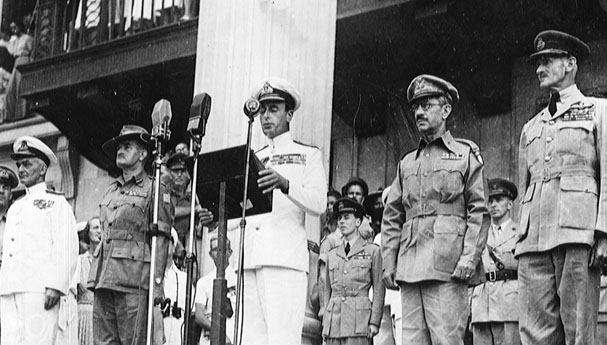
On 12 September 1945, an impressive victory procession was held at the Padang.


Lord Louis Mountbatten accepted the Japanese surrender at the City Hall. The British flag was raised again and Singapore came under the British’s rule once more.


Every citizen, including Toh, Mei and Cheng was at this historical venue to witness the official ending of the War. There were much frenzied celebrations, with much jubilation that harsh times had ultimately ended.


After the War, normal living activities resumed. At work, Mei and Cheng met and were married a year later.


Mei and Cheng were my parents who lived through the Japanese Occupation. My late father lived many years to recount these true stories. My mother who passed on recently, recalled those difficult years frequently to me.


If they had not survived the War, it would be impossible for the writing of this account in memory of both my parents who later became Christians.


Thank God for preserving the family line, that the present generation has the privilege to know His name and become His children.


Thank God for what He has done in the past that the future generation can live on.


All Glory be to God! Amen


Note: Only names are fictitious, all others are true stories.


Saturday, March 27, 2010

THE MIRACLE TREE OR MORINGA OLEIFERA

IMPROVE YOUR DIET WITH THE MIRACLE TREE, THE LEAST KNOWN NUTRITIONAL TREE OF THE CENTURY

Three months ago, I was having a conversation with a Indian friend. Somehow we talked about foods and herbs. Then she introduced to me a herb that has been existing here in Singapore, but known mostly by the Indians of Singapore.

The plant or the tree is called drumstick tree . I eventually went to The Little India of Singapore and bought some drumsticks and fresh leaves. Some of the pictures are shown here. They are inexpensive and so available, both air flown from India on a daily basis.
Let me explain the wonders of this plant. It is the most unknown most nutritious plant, all the parts of this tree can be used as nutrition to the body. However, due to economic reasons, the leaves and the pod are used more widely.

MORINGA OLEIFERA OR THE MIRACLE TREE
The botanical name for this tree is MORINGA OLEIFERA.
It is extremely rich in vitamins and minerals, amino acids so crucial for our body.
In addition, this plant contains anti-toxin and anti-oxidant materials which helps to strengthen the body’s immune system, for gout and arthritis, for lactating mothers, and much more.
It is of no wonder that this tree is known all over the world as the miracle tree.


I found this tree has been planted in Singapore, one of the example is at a house in the east side of Singapore, near Bedok.
The origin of this tree is from India, and was grown over thousand of years to treat various diseases and for nutritional supplements. This tree is known by different names in different parts of the world. Please see below for information.


NUTRITIONAL VALUE AS VERSUS OTHER FOOD
If you compare the nutritional values of this plant with other natural foods, you will have some ideas how nutritious this plant is.


It is 3 times more iron than spinach
It is 4 times more vitamin A than carrot
It is 4 times more calcium than milk
It is 2 times more protein than milk
It is 3 times more potassium than banana


The vitamin contents of this tree are as follows:
Vitamin A, vitamin B1, Vitamin B2, Vitamin B3, Vitamin C, Calcium, Copper, Iron, magnesium, Phosphorous, Potassium, Zinc.
Amino acids are arginine, histidine, isoleucine, lysine,methionine, phenylalanine, threonine, tryptophan, valine


USES OF MORINGA OLEIFERA
The use of Moringa Oleifera are as follows:
• Strengthen the immune system
• Cleanses body from toxins and heavy metals
• Exterminate parasites in the intestines
• Support treatment during radiation and chemotherapy
• Support treatment during lack of appetite in children and adults
• Help with osteoporosis treatment
• Help with diabetes treatment
• Intestine infections
• Gum infections
• Prostate infections
• Various skin disease
• Breathing disease
• Headaches and migraines
• Arthritis
• Gout
• Hair loss


MORINGA SUPPLEMENTS


Consistent intake of Moringa will help the following supplement :
1. Prevent glaucoma and cataract
2. Treat insomnia
3. Increase sperm count and motility
4. Rebuild weak bones and prevent osteoporosis
5. Enrich anemic blood, prevent anemia
6. Increase milk flow for lactating mothers, nourish breastfed babies
7. Decrease liver disorder
8. Relieve colds
9. Promote a healthy circulatory system
10. Provide anti-inflammatory effects
11. Combat malnutrition
12. Prevent childhood blindness
13. Promote normal serum cholesterol
14. Enhance red blood cells
15. Mitigate the aging process
16. Remove fine lines and wrinkles
17. Aid metabolism and digestion
18. Stimulate the brain and enhance mental alertness, alleviate stress
19. Improve strength and endurance
20. Ease the symptoms of menopause , hormonal changes and depression


MORINGA IN VITAMIN FORMS
I have bought several ready prepared Moringa Oleirfa in powder and tea bag forms. This is for those who have no available stocks of the tree or they are too busy to purchase the fresh ones on a regular basis.


I found the followings from some companies and have bought them.


These are in powder forms from 4 companies:


 1) Ilovemoringa.com


2) Enjoymoringa.com


3) Themoringa.com


4) Moringaoleifera.org
5) moringa.com.my
After all the explanations, I would encourage you, the readers to introduce this plant into your diet, whether you take them in the fresh natural form, if available in your country, or to take then in vitamin forms.
You may read more from the following websites:
http://www.treesforlife.org/our-work/our-initiatives/moringa/names-of-moringa
http://www.treesforlife.org/our-work/our-initiatives/moringa


DIFFERENT NAMES OF MORINGA IN DIFFERENT PARTS OF THE WORLD
Other names for the Moringa in English include:
Drumstick tree, from the appearance of the long, slender, triangular seed pods.
Horseradish tree, from the taste of the leaves, which can serve as a rough substitute for horseradish.
Ben oil tree, from the oil derived from the seeds
The Chinese name of the Moringa (辣木), pronounced "la mu" in Putonghua and "lat mok" in Cantonese, means "spicy (hot) wood", and is reminiscent of the English name "horseradish tree".
In some Indian languages, the name is phonetically somewhat similar to "moringa", while in others it is quite different:


In Tamil it is called Murungakka in singular form, the plural form being Murungakkai.
In Hindi it is called Munuga.
In Marathi is it called Shevga.
In Kannada it is known as Nuggaeekayee.
In Telugu it is called as Mulakkaya.
In Gujarati is it called Saragvo.
In Oriya is it called Munika.
In Bengali it is called Sojne danta.
In Kerala state its known as Muringa Tree and the fruit called Muringakka in Malayalam.
In Nepali it is known as Sajiwan or Swejan.
In Guyana it is called Saijan
The Tagalog name, in the Philippines - Malunggay - is also phonetically similar to "moringa". In Ilocano, another Filipino language, its called Marungay. It is called "Kamunggay" in Bisaya.
In Haiti, the moringa is called the benzolive (or benzolivier).
In Nicaragua the plant is referred to as Marango.
In Indonesian, the moringa is called kelor. In Javanese, it is called limaran.