This is a true life story of God’s protection of a family line. Read this true story that proclaims the miracle of God that the present generation will honour His name.

Meanwhile Mei waited nervously. Upon the arrival of other neighbours, the woman crowd hastily grabbed some food and hurried into the adjacent jungle to hide.
This routine lasted the entire duration of the Japanese Occupation. Youthful women camouflaged themselves, wanting to elude male soldiers’ interest. Many women were sexually abused by brutal soldiers since the War started.
After dusk, Mei returned home. She would then retire beneath the antique bed in the only bedroom of the house. Nightly, Mei hid below the bed. Sides were hoarded after she was beneath it. There she lied until the next day. This was her hideout nightly until the War ended.

In that era, it was difficult recruiting young girls for schooling. Parents refused them a formal education. Females were seen as inferior, having to marry at 16 and hence belonged to their in-laws. Parents spent scarcely on them, including education!
Furthermore, parents detested their daughters adorning skirts. They objected the expose of their bare legs with skirt as the uniform. They loathed men goggling at their daughters’ delicate legs.
That explained why Mei was admitted late at 13. Her mother was ultimately convinced that her eldest daughter should pursue some basic education.

The War changed Mei’s life completely. The Japanese invaded Singapore on 15 February 1942. They occupied Kuala Lumpur up north a month earlier. Next, they advanced with speed and ferocity towards south towards Singapore.
Several years of War resulted in the invasion for vital natural resources. Singapore was also essential as a launch pad for the War. At the tip of Malaya Peninsular, Singapore was a major British military base, being founded in 1819 by a British statesman, Sir Stamford Raffles.

Within a week of intense fighting in the north and severe air-raids in the south, Singapore was conquered rapidly without much resistance.
The Fall of Singapore was the greatest defeat, probably Britains’ worst defeat in WWII. Singapore was a vital part of the British Empire and was considered impregnable as a fortress, even having the name “Gibraltar in the Far East”. The Japanese later changed its name to “Syonan-to” meaning “The Light of the South”.

Concurrently, in another part of the island lived a 25 years old Chinese man. He came 17 years earlier from China, an orphan with his elder sister who controlled the family heirlooms.
For years, Cheng lived a leisure life. Living on the wealth of his late parents, he frequented the coffeeshops and spent his time discussing the latest politics in China. He led a fervent following and raised funds for the Sino-Japanese War.
When WWII arrived, Cheng was singled for spreading propaganda. Collectively with many men, they were arrested and placed in a converted prison at Fords Factory in Bukit Timah Road. The Japanese targeted mainly the Chinese. Other races were momentarily out of danger.

When he regained conscious, he realised his four limbs were tied up, his body was secured onto the mud floor. Then he heard a command shouting, “ Iku “, meaning “Go”.
Immediately, a heavy corporal with military boots jumped mercilessly onto his bloated tummy. They repeated the torture numerous times. They kicked hard at his limbs. He was beaten until he fainted. Then they left him alone .
Next Cheng recollected being forced to arise and was dragged onto a military truck. Together with many men, they were ferried to a secluded spot at Changi Beach, a 2 hours journey to the north. Every man then proceeded towards the beach, totally blindfolded.
Abruptly, Cheng felt someone forced him aside. His tied hands were crudely loosened. Although he could not understand the soldiers, he knew instinctly what was happening.
He saw many men lined up in front of a firing squad. With the command “Iru” meaning “Fire”, the men felled, shot point blank and dead in a moment.
The same procedure was carried out until 99 men were killed. Every of the 100 men were dead except Cheng !! Then the Japanese soldiers left. Cheng was deserted.
Without warning he was abandoned with all the dead corpses. He looked in disbelief at the lifeless bodies.They were his comrades and his neighbours!
Slowly it dawned on him that he was the only one spared. For whatever reason, he knew not. He slowly found strength and then began walking, bit by bit towards Chinatown. Along the way, he hitched a ride on a nightsoil truck.
At home, only did his sister revealed her bold plan of bribery of the soldiers, and how she willingly gave all the valuables, meant for his marriage, to exchange for his life.

For the next 3 and half years, both of Mei and Cheng’s households suffered extreme lack and much misery. There was insufficient food or commodities in the market.
The Japanese issued their own currency. The ‘Banana’ currency was used to barter goods. Pork , sugar and rice were sold once monthly, half kati for each family.
The locals supplemented food with sweet potatoes and tapiocas from their backyards. For clothing, they used old curtains and alter them into garments.

Mei’s father, Toh was in the Port when the torpedos started . He was alone in the vessel with his colleague, Ahmad.
Upon hearing the approaching planes, they bent down to avoid the torpedo shots. But one shot ruthlessly sliced Ahmad’s head off. The Malay man was killed instantaneously before Toh’s very eyes. Miraculously Toh was not harmed, his body fully intact.
Nonetheless, when Toh reached his Henderson Kampong home, he was in a state of bewilderment. He would act eccentric, even after the War. Witnessing the abrupt killing of his colleague was too much for him.

Those harsh years of the Japanese occupation brought much adversity. The locals lived in constant fear. It was mandatory to bow to any passing soldiers. Anyone who refused would be severely punished.
In schools, Chinese was forced to study the Japanese Language and had to learn the Japanese National Anthem. Only Japanese movies and propaganda films were screened in cinemas.

Against all odds, when the WWII ended abruptly in 1945, there was great jubilation and ecstasy .
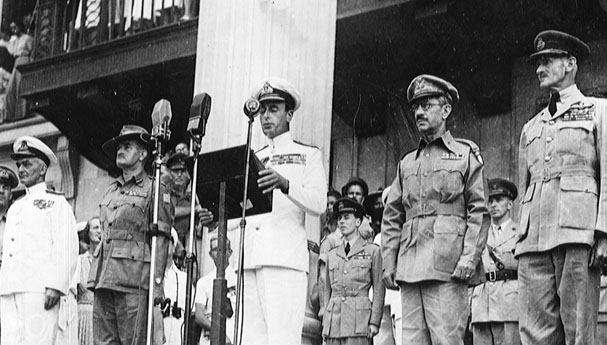
On 12 September 1945, an impressive victory procession was held at the Padang.
Lord Louis Mountbatten accepted the Japanese surrender at the City Hall. The British flag was raised again and Singapore came under the British’s rule once more.
Every citizen, including Toh, Mei and Cheng was at this historical venue to witness the official ending of the War. There were much frenzied celebrations, with much jubilation that harsh times had ultimately ended.
After the War, normal living activities resumed. At work, Mei and Cheng met and were married a year later.
Mei and Cheng were my parents who lived through the Japanese Occupation. My late father lived many years to recount these true stories. My mother who passed on recently, recalled those difficult years frequently to me.

If they had not survived the War, it would be impossible for the writing of this account in memory of both my parents who later became Christians.
Thank God for preserving the family line, that the present generation has the privilege to know His name and become His children.
Thank God for what He has done in the past that the future generation can live on.
All Glory be to God! Amen
Note: Only names are fictitious, all others are true stories.


 Posts
Posts